
A Fool and His Army
The Fierce Urgency of Keeping the Republic

America has always had its lunatic fringe. We’ve suffered the presence of radicals, crackpots, racists, revolutionaries, fascists and fools. Some had influence, maybe winning an electoral upset, circulating an inflammatory pamphlet, or appearing on radio. But they were few, poorly organized, and not to be taken seriously.
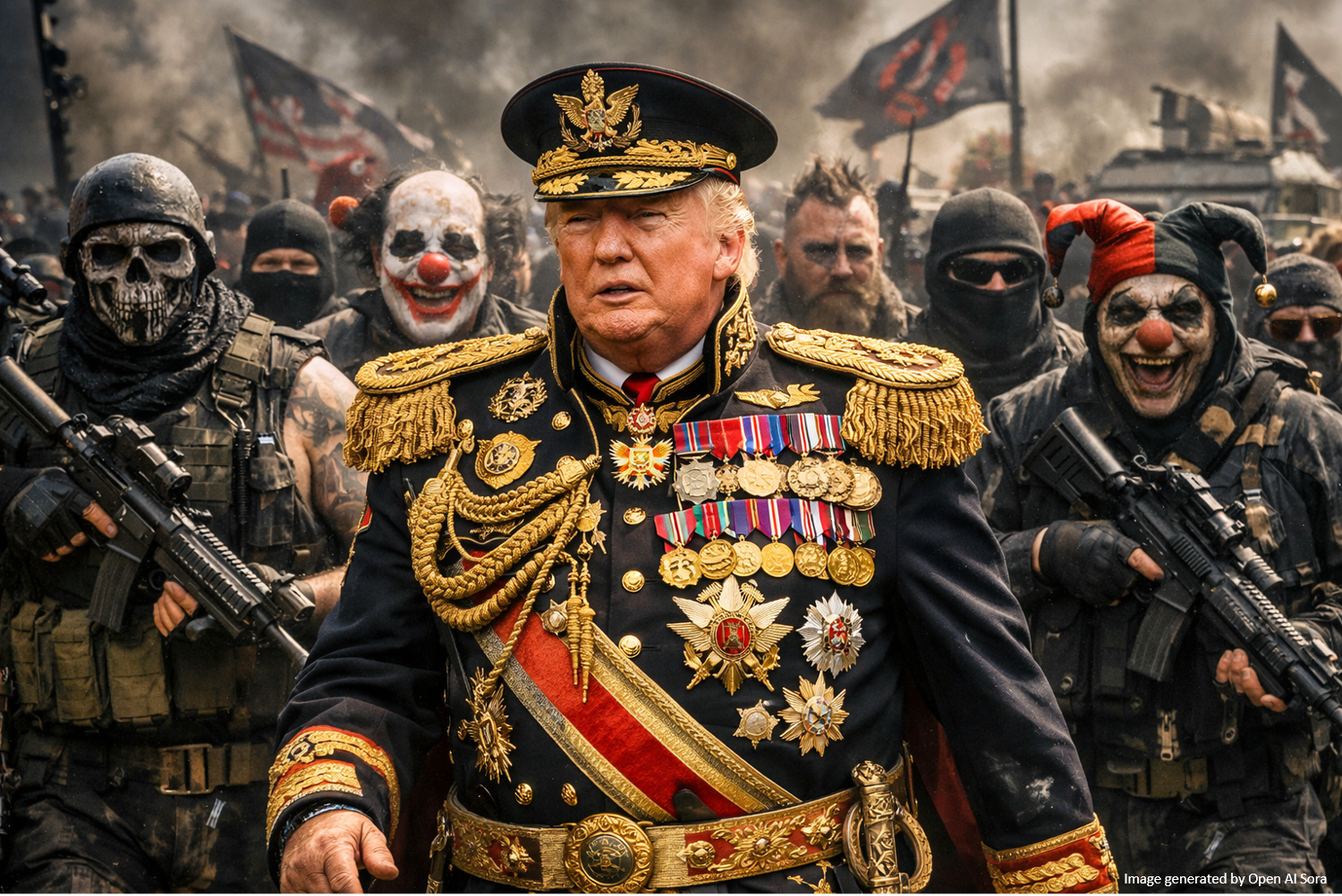
In 2026 they hold power and their leader has assembled his own personal army.
The army was drawn from ICE, the Border Patrol, and other federal agencies. Those affiliations are meaningless. While described as a deportation force, it’s Trump’s army, loyal to the stucco-faced potentate and led by the Gríma Wormtongue of the West Wing, Stephen Miller.
Years ago, there was a billboard along the highway to Phoenix that read, “Get US Out of the United Nations!” It was funded by right-wingers nursing a McCarthyism hangover. “(T)here are more Communists in the United Nations building in New York than there are in the Kremlin,” wrote Robert Welch, founder of the John Birch Society, in 1965.
The Birch Society “is a conservative organization aimed at combating what it perceives as a communist conspiracy in the United States,” wrote Gina R. Terinoni for EBSCO. But they were little more than noisemakers with billboards until something portentous happened: Republican leaders thought they could exploit the group’s energy while retaining immunity from its madness.
Historian Matthew Dallek wrote that “much of the responsibility for the continuing vitality of Birch-style extremism lies with Republican leaders who thought they could harness the activism of the Birchers without allowing their paranoia and hatred to define the party.” “The GOP establishment’s efforts to court this fringe and keep it in the coalition,” he noted, “allowed it to gain a foothold and eventually cannibalize the entire party.”
Welch died in early 1985. Later that year 60 Minutes Correspondent Mike Wallace interviewed an ambitious New York developer named Donald Trump. After a tenant referred to Trump as “a very arrogant human being who really doesn’t care about the lives of people like you see in this room here,” Wallace asked Trump, “Does that get under your skin?” “No,” answered Trump, “because you see I think I’m right.”
That was Trump the developer, but Trump the candidate was gestating. Two years later, while promoting The Art of the Deal in New Hampshire, he made a surprisingly political speech. After ruling out a 1988 presidential run, he issued a dire warning: “If the right man doesn’t get into office,” he said, “you’re going to see a catastrophe in this country in the next four years like you’re never going to believe. And then you’ll be begging for the right man.”
“His speech was nativist and isolationist,” wrote Michael Kruse of Politico in 2016, “an angry, gloomy rant about America losing out in a dangerous world. His message of failure—American failure—has been remarkably constant since that moment 28 years ago.”
As GOP leaders worked to “court this fringe and keep it in the coalition,” Trump became the avatar of political decay within the GOP. Four decades later, their souls confiscated by radicals, Republicans in Congress gave him an army.
Right-wing extremists’ anti-communist posturing was a targeting mechanism for people like Senator Joe McCarthy who used the accusation of communism against their opponents. “McCarthy found few, if any, communist spies,” wrote George Friedman in Geopolitical Futures. “But he used the charge of communism as a tool to discredit and destroy those he disagreed with.” McCarthy was aided by a young attorney named Roy Cohn, who later mentored Donald Trump.
“Cohn understood that people who are afraid—of communists, of crime, of social change, of the ‘other’—are easier to manipulate,” noted book reviewers at Berrett-Koehler, “and more willing to accept authoritarian solutions.” His apprentice paid attention.
“We should take over the voting, the voting in at least many — 15 places,” Trump said recently. “The Republicans ought to nationalize the voting.” “You’re damn right we’re going to have ICE surround the polls come November,” added Trump ally Steve Bannon. “We’re not going to sit here and allow you to steal the country again.”
Trump and his MAGA brethren are planning to unleash their army on election day, intimidating voters at the polls, confiscating votes, and manipulating results. “We are now faced with the fact that tomorrow is today,” said Martin Luther King, Jr. in 1965. “We are confronted with the fierce urgency of now.”
In 2026, we must bring fierce urgency to protect the sanctity of free and fair elections. Warn everybody who will listen of the threat. Use Bannon’s words. Make them feel the urgency. Congressional Democrats and patriotic Republicans (those few that remain) should refuse new Homeland Security funding for Trump’s army and claw back most of what has been appropriated. Its budget is “larger than the annual budget of all other federal law enforcement agencies combined,” notes Lauren-Brooke Eisen of the Brennan Center for Justice.
“Every state provides options for at least some voters to cast their ballots without having to appear in-person,” notes the Movement Advancement Project. Every voter should be encouraged to vote by mail to avoid harassment at the polls by ICE.
Finally, identify polling places ICE is likely to target and flood the perimeter with volunteers and cameras to keep them away. Don’t allow Trump’s army to block access or intimidate voters.
On September 17, 1787, Elizabeth Willing Powel asked Benjamin Franklin whether the Founders gave us a republic or a monarchy. “A republic,” he replied, “if you can keep it.” On November 4, 2026, let us summon the spirits of Franklin and King and tell them this:
“We brought the fierce urgency. We kept the republic.”