

I’m Your Host, Stephen Colbert. Good Night!
Did Streaming Kill the Video Star?

Media ThenWhen I was little, I spent the day at my grandparents’ house. Grandma Sarah took care of me – which means she indulged and endured me. The radio constantly played serials, dramas, and soap operas – but no music. I listened to them daily.
Then a strange thing happened. Nearly all those radio serials that careened from plot line to plot line suddenly wrapped up. Lingering romances culminated in proposals. Master villains were brought to justice. Every plot wound down and the shows signed off. The next day the radio played music. Something made the serials go extinct.
My grandparents invited that something into their home: a large black and white television. My parents bought one later. The radio shows could not compete with TV. Then, one day at the County Fair, I saw something amazing: color television. The set displayed The Perry Como Show. What struck me was the curtain: it was a vibrant, defiant, purple. I was mesmerized. Soon, every show was in color.
A few years later, we redefined what came to be known as “appointment television.” Our favorite shows had set the appointments; we just showed up. Then we learned to schedule the appointments ourselves with video cassette recorders. We had more control. Interactivity was born.
Along came cable and choices exploded. Gone was the network monopoly of a handful of channels, shoved aside by new options from Turner Broadcasting, ESPN, Home Box Office, and so on. And, of course, MTV.
The Buggles captured media Darwinism in “Video Killed the Radio Star.”
They took the credit for your second symphony
Rewritten by machine on new technology
And now I understand the problems you could see
“The song is about those musicians whose careers were destroyed because they would not translate visually to television,” noted the Genius website. “Adequate to this theme, the music video for the song was famously the first aired on MTV, at 12:01AM on August 1st, 1981.”
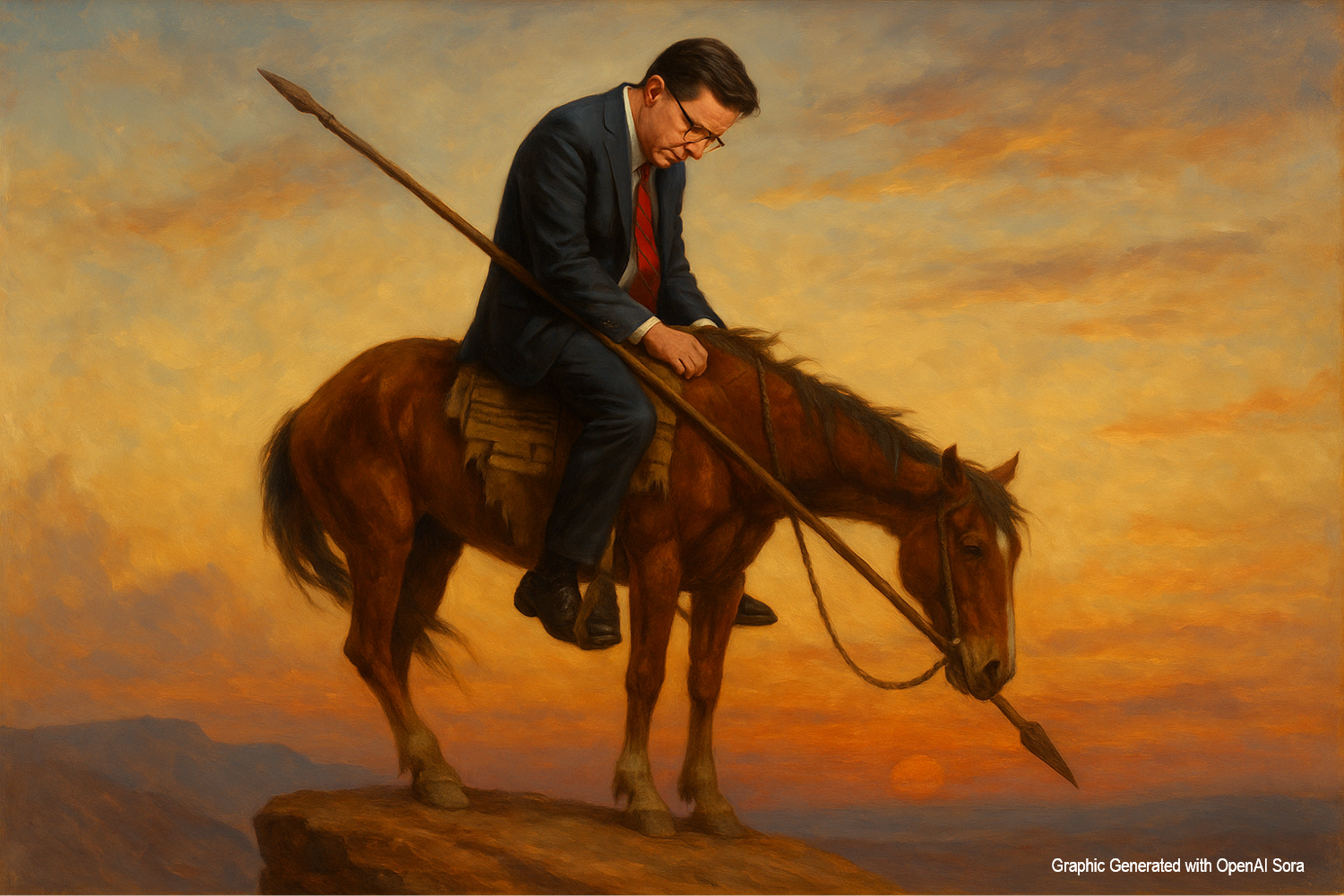
Media NowSince Steve Allen debuted The Tonight Show in 1954, the late-night format has ridden the tides of media change. Hosts came and went: Steve Allen, Jack Parr, Johnny Carson, Jay Leno, David Letterman, and others, but the format endured. More recently, late night appointment television meant Jimmy Kimmel and Jimmy Fallon. And, of course, Stephen Colbert, who was recently given a time-delayed pink slip. CBS is cancelling The Late Show altogether after next May.
The network insists the cancellation was “purely a financial decision.” As Justin Charity of The Ringer notes, there is evidence to support that.
“The Late Show reportedly employs more than 200 people and costs more than $100 million per season to produce,” he wrote, “while losing CBS about $40 million each year. Paramount Global, CBS’s parent company, recently cut 3.5 percent of its workforce—that’s several hundred employees—citing economic challenges and a worrisome outlook in traditional broadcast television. Late-night talk shows, in particular, are a vestigial format with vanishing appeal to the sort of younger viewers coveted by advertisers.”
But that ignores the blonde elephant in the room. Colbert has been one of Donald Trump’s most eloquent and effective critics. “With a year to go before ‘The Late Show’ takes its final curtain call, is Colbert's cancellation part of the ordinary ebb and flow of network television?” asks Rafi Schwartz, writing for The Week. “Or is his show a canary in the coal mine amid increased political repression by the Trump administration?”
The Writers Guild of America suspects the latter. “Cancelations are part of the business,” wrote The Guild, “but a corporation terminating a show in bad faith due to explicit or implicit political pressure is dangerous and unacceptable in a democratic society. Paramount’s decision comes against a backdrop of relentless attacks on a free press by President Trump, through lawsuits against CBS and ABC, threatened litigation of media organizations with critical coverage, and the unconscionable defunding of PBS and NPR.”
One person who reinforces this view is Donald Trump. “I absolutely love that Colbert got fired,” he wrote. “His talent was even less than his ratings.” (As a devout fan, I endorse Colbert’s succinct reply.)
Media NextTwo things can be true at once; that is the case with Colbert’s cancellation. Younger viewers have migrated to a digital diaspora. My grandson used to watch Paw Patrol on TV when we brought him home from preschool. Now, he reaches for his tablet. Every eyeball that gravitates toward a portable screen and away from a fixed one alters the financial reality of the media world and irrevocably changes it.
But it’s naïve to deny that fear of Trump lubricated the cancellation. “The announcement by CBS on Thursday that it will cancel the show,” writes Andy Hirschfeld in Al Jazeera, “comes against the backdrop of a looming merger between its parent company, Paramount, with Skydance Media.” (Paramount needs the Trump administration’s blessing for the merger.) It also comes in the wake of Paramount’s spineless surrender in a frivolous Trump lawsuit settlement that Colbert called a “big fat bribe” on July 18th. CBS announced The Late Show cancellation the next day, undoubtedly to the sound of corks popping in the boardroom.
Trump will eventually leave the scene. American politics, ever on a hinge, will likely swing back to the left in 2026 and 2028. America will stumble on, scars and all.
Media’s future is not on a hinge; it’s on a ratchet. My television era was the Paleocene; my grandson’s will be a new media Holocene. His will be a radically different world.
As for my world: I’m happy with it – as long as there’s a place for Colbert.
There will always be a place for Colbert. He can continue hosting the Emmys or follow in Conan O'Brien's footsteps to bring late night to podcasts. Many opportunities to come. Instead the loss is ours to bear because losing late night shows means families lose their "appointment television" time. Great post!