

Jesus, What an Ego
A Low-rent Messiah with an Edifice Complex

Years ago, when I was practicing law full time, I read a New York mobster’s last will and testament. The only thing I remember is the extensive first section. It went on and on, with exhaustive details about his – mausoleum.
He specified the color. He described the design, the elements, the construction materials. The rest of the document read like an afterthought. The will would decide who gets what, but that wasn’t important to the testator. Before he got to that, he wanted to ensure a monument to his glory.
I had forgotten about the mobster’s will until I saw the drawings of Donald Trump’s so-called “Triumphal Arch.” As with the mausoleum, the arch is a monument to the greatness of its designer – and, at least in Trump’s case – as evidence of mental illness.
“Certain physical structures may symbolically represent internal psychological states,” noted Kevin Volkan, writing in the European Journal of Psychoanalysis. “Structures, like bunkers, monuments, and walls are especially rich in psychological meaning.”
“This sort of bunker mentality was seen during Hitler’s leadership of Nazi Germany and is now evident with Donald Trump, the current president of the United States,” he adds. “Bunkers, bunker-like structures, and grandiose monuments provide pathologically narcissistic leaders with a source of adulation that feeds their grandiose self.” Volkan adds that such behavior may indicate “the leader suffers from pathological or malignant narcissism.”
Unlike the mausoleum, Trump’s creation would not be in a sedate, private setting among quiet trees and tombstones. It would be relentlessly inescapable.
“New architectural drawings of President Donald Trump’s controversial proposed ‘triumphal arch’ released on Friday,” reports CNBC, “show a 250-foot structure standing across the Potomac River from the Lincoln Memorial in Washington, D.C.” It would be two and a half times the height of the Lincoln Memorial and nearly as tall as the U.S. Capitol.
While White House staffers told NPR the arch “is intended to serve as, ‘a fitting recognition of America’s 250th birthday,’” it’s all about Trump. “When asked by CBS political correspondent Ed O’Keefe whom the monument was intended to honor after Trump initially unveiled his plans in October,” reports NPR, “Trump responded: ‘Me.’ The exchange was captured in a social media video.”
The second Trump administration is the “me” presidency. The proposed arch is the latest endorsement of his life’s mission: unapologetic self-veneration. He demolished the East Wing to replace it with a gilded, giant ballroom that would dwarf the White House. If built according to current plans, it would ensure that future presidents would live and work in the shadow of Trump’s ego.
The President ordered his name affixed to the John F. Kennedy Center for the Performing Arts and the U.S. Institute of Peace. Large banners with Trump’s face were slapped onto buildings in Washington, including the Departments of Agriculture and Labor and, in a move described by California Governor Gavin Newsom as “beyond parody,” the Department of Justice. “How many dictatorship-style monuments, building name changes, and fake awards do Americans have to endure?” asked Newsom.
Spoiler alert: a lot. “As the first year of President Donald Trump’s second term wraps up,” reports LiveNOW, “the Republican administration and his allies have put his name on various things, including buildings, street signs and warships.” There are proposals to name Washington D.C.’s transit system and Washington Dulles International Airport after Trump.
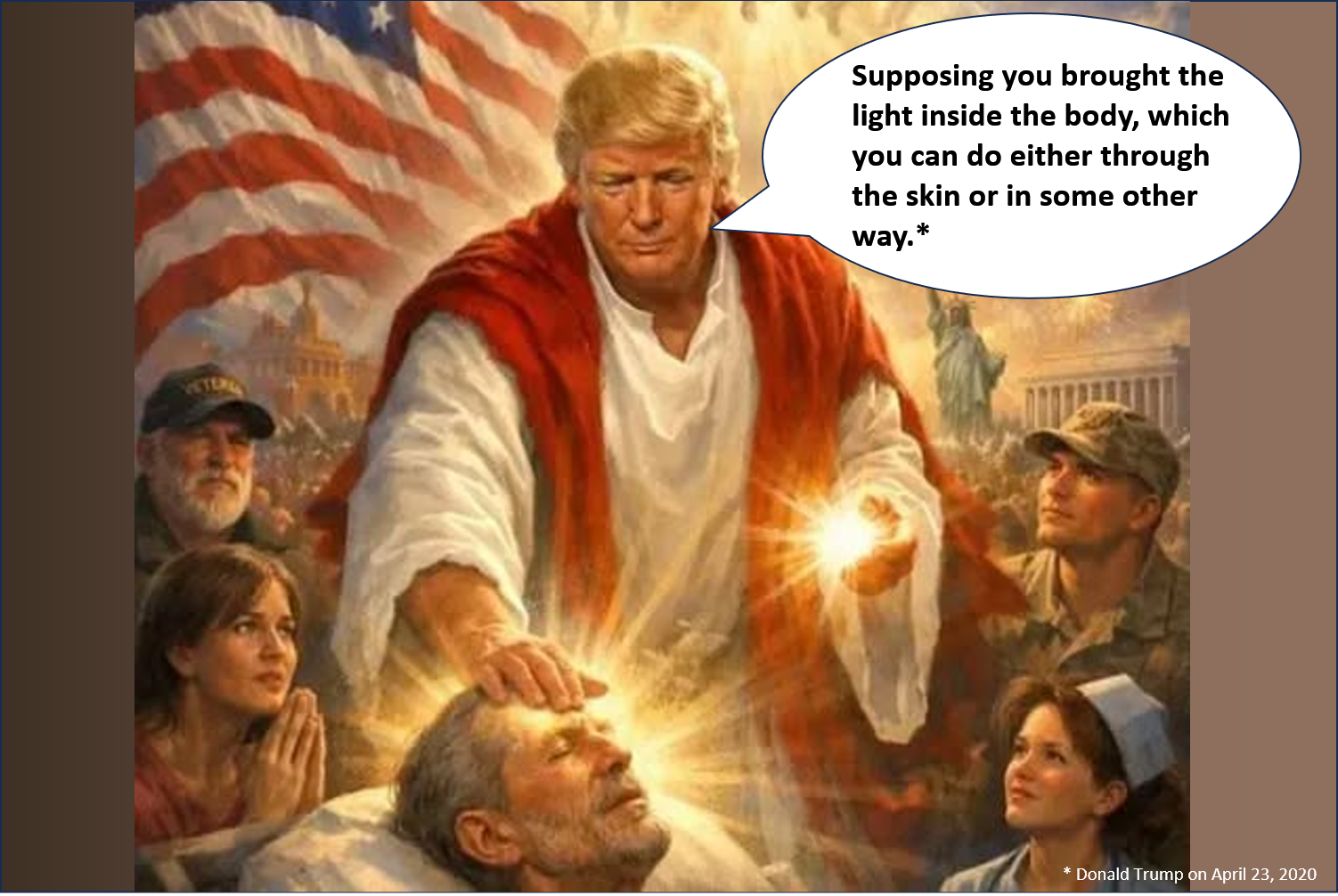
For those who think this is insufficient evidence of pathological or malignant narcissism, consider the picture. “The image had showed Mr. Trump dressed in white and red robes, with the president’s hands emitting shining lights,” writes Claire Moses in the New York Times. “His right hand was touching the forehead of a man lying on a bed in a hospital gown, evoking religious art that depicts Jesus healing the sick.” This was a week after Trump dropped an “F-bomb” on Easter Sunday.
Trump claimed he was not portraying Jesus, but a physician. “It’s supposed to be me as a doctor,” claimed the man who advised people to drink or inject disinfectants, “making people better, and I do make people better.” Trump’s mismanagement of the Covid pandemic led to thousands of avoidable deaths in the United States. Perhaps he suggests they are better off dead?
“In his second term, Mr. Trump seems even less restrained and more incoherent at times,” writes Peter Baker in The New York Times. “He wanders off into odd tangents,” added Baker, “an eight-minute ramble at a Christmas reception about poisonous snakes in Peru, a long digression during a cabinet meeting about Sharpie pens, an interruption of an Iran war update to praise the White House drapes.”
Despite that, Trump’s supporters rallied behind him. Then came the Easter F-bomb and the Jesus picture.
“Democrats who have long challenged Mr. Trump’s psychological fitness have issued a fresh chorus of calls to invoke the 25th Amendment to remove the president from power for disability,” notes Baker. “But it is not just a concern voiced by partisans on the left, late-night comics or mental health professionals making long-distance diagnoses. It can be heard now among retired generals, diplomats and foreign officials. And most strikingly, it can be heard now on the political right among onetime allies of the president.”
Trump has a Rasputin-like ability to escape a political death spiral by relying on the limited attention span of his followers, who might forget in November how they felt in April. In Trump’s world, short-term memory is blasphemous.
Most Americans don’t live in that world. Come election day, they’ll flip congress and neuter his political power.
Trump won’t be idle. He can always cosplay a messiah at Mar-a-Lago.