

Lipstick On a Pig
Trump’s Dangerous Over-Compensation

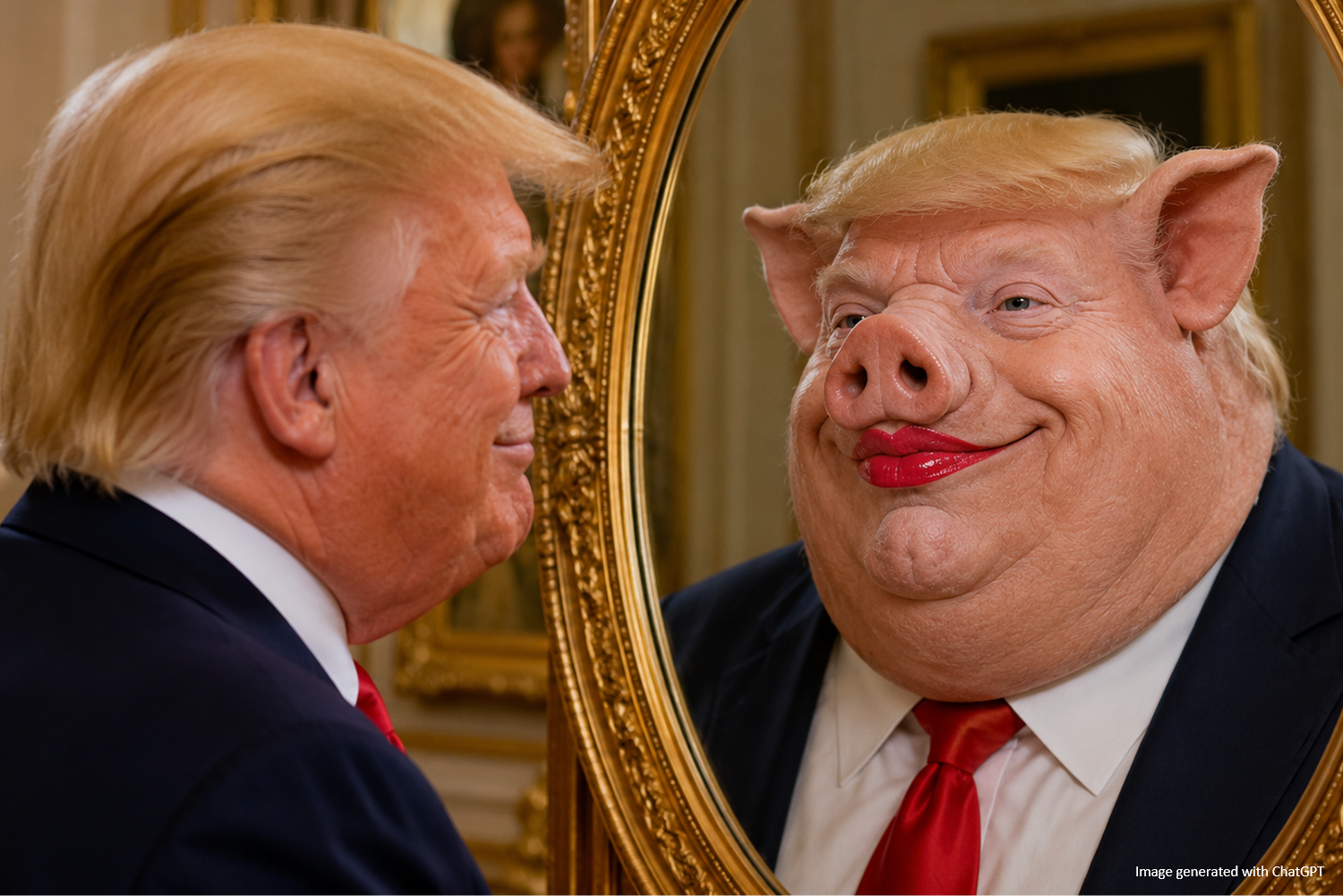
Denial is only skin-deep. It never fully conceals what lies below. You can apply layer upon layer of avoidance, deflection, defiance and delusion, but the patina still runs thin. Others may or may not see through it, but you can. You know what’s there. Opacity dies on the altar of transparency. No matter how fulsome the lips, or bright red the lipstick, you can’t look away from the pig.
When Donald Trump stares at the mirror, he sees what the rest of us do: the oxidized clay makeup, the thatched haystack atop his skull, the saddlebag jowls. But Trump sees more than a mere reflection. He sees an historical figure, a conqueror, a master builder. A man of gold.
Like a Bond villain, Trump loves gold. When he reoccupied the Oval Office, he festooned it with gold adornments, what he calls “Trump touches.” “The results have split opinions,” noted The Guardian, “with some calling the revamped office a symbol of America’s new golden age, while others have compared it to a professional wrestler’s dressing room.”
“Over the months of his administration,” adds The Guardian, “the number of gold trophies and vases littered across the mantlepiece have multiplied and there are now even gold coasters with Trump’s name on them.”
Trump does not confine his obsession to Oval Office ornamentation. He stomps on the nation’s capital like the progeny of King Midas and Godzilla, marking his territory everywhere, as noted by NPR: the Reflecting Pool, local golf courses, a sculpture garden, various statues, a gigantic out-of-proportion “Triumphal Arch,” an obscenely large and intrusive ballroom where the East Wing used to be, placement of his name on federal buildings, and a sadly paved-over Rose Garden.
Why is he doing this? Some observers believe his obsession with golden adornments and monuments to himself is compensatory behavior, an attempt to mask a reality he has run from since he was a boy. These things gloss over that reality, but fail to conceal it -- like lipstick on a pig.
“The fact is, it can’t be easy to wake up every day and discover that you’re still Donald Trump,” wrote Jeffrey Kluger for Time in 2015. “You were Trump yesterday, you’re Trump today, and barring some extraordinary development, you’ll be Trump tomorrow.”
“The problem with being Trump is the same thing that explains the enormous fame and success of Trump,” he adds, “a naked neediness, a certain shamelessness, an insatiable hunger to be the largest, loudest, most honkingly conspicuous presence in any room—the great, braying Trumpness of Trump—and that’s probably far less of a revel than it seems.”
Dr. Brad Bowins, a clinical psychiatrist, believes Trump suffers from narcissistic personality disorder. “Donald Trump’s early life experiences virtually ensured profound insecurities and self-doubts,” he wrote. “His father was a critical disciplinarian who did not demonstrate any emotional support for his children. Lack of praise and severe criticisms were the norm, and the children were hit or grounded for days due to any violation of the rules.”
Bowins suspects this treatment fed into Trump’s narcissistic personality disorder. “When a person has profound insecurities and weaknesses perceived or real,” he wrote, “the compensation can become extreme producing narcissistic personality disorder.” He adds, “The overcompensation is so intense that it causes suffering for those around the person. For example, intrusive, aggressive, and domineering behavior.”
Trump is a man reduced by wants unmet and love withheld, trying to anesthetize the pain of his upbringing with a manufactured illusion of greatness in his adulthood.
“A consensus now exists that narcissists hide, both from themselves and others, deficits in their self-image” noted Leon F. Seltzer, PhD in Psychology Today. “What makes narcissists over-compensate—vs. compensate,” he adds, “for their chronic anxieties and insecurities is that, deep down, they believe that to be okay, they must be more than okay.”
Narcissists’ habit of “overcompensating for never-healed psychic wounds from the past,” adds Seltzer, “takes the form of discounting others’ happiness or prosperity so they won’t be compelled to admit that anyone has it better—or has done better—than they.”
“He has a primitive attraction to the big, the grand, the colossal,” wrote Philip Kennicott of Trump in The Washington Post. “When he speaks, he uses superlatives reflexively, and he brings the same sensibility to architecture.”
“He appears utterly uninterested in basic American values, history and symbols,” adds Kennicott, “and so there are no guardrails, no limits, to the damage done by his other failings.”
The “damage done by his other failings” extends beyond buildings and monuments. Trump’s presidency has gone demonic. His governance is less inspired by public service than by slavish obeisance to the dark temptations of his inner devils.
“His overcompensation is so extreme that it has caused enormous suffering,” observes Bowins, “such as: tens of thousands of Americans dying of Covid-19, an occurrence potentially influenced by his not listening to medical authorities and following their advice in regards to masks and vaccines; the many women who allegedly were sexually abused by him; Hispanics and others deemed undesirable arrested without due process and shipped away; threats to take over countries that have been allies of the United States; disruptions to countless businesses from his volatile and discriminatory application of tariffs; personal attacks on those he feels have crossed him using the power of the presidency. The list is virtually endless and grows by the day.”
The unloved boy who presides over these things stands at a mirror and admires the deliberately curated hero looking back. As for the rest of us:
We know a pig when we see one.