

The Bronzer Age
The Schematic of Fascism

I. Prehistory
Thousands of years ago, humanity’s ancestors learned to pull minerals from the ground. They discovered copper, learned how to separate the ore from impurities, then fashion it into tools and weapons. The Stone Age was ending. Early alchemists learned to combine copper with tin, and the Bronze Age was born.
“Like the Stone Age that came before it and the Iron Age that followed,” writes History Facts, “the Bronze Age marked a major stage in the evolution of civilization. But it wasn’t defined by metallurgy alone: It was also a time of urbanization and cultural advancements.”
“Humans made many technological advances during the Bronze Age,” notes History.com, “including the first writing systems and the invention of the wheel. In the Middle East and parts of Asia, the Bronze Age lasted from roughly 3300 to 1200 B.C., ending abruptly with the near-simultaneous collapse of several prominent Bronze Age civilizations.” Next came the Iron Age, the last prehistoric age.
II. History
Early history was carved; recent history is written. The modern chapters are shorter, more focused, and debated. We are currently in the Modern Era.
Nations have individual histories. France, for example, has experienced five different republics during its long, painful extrication from monarchy.
“Americans pride ourselves, by contrast, on our undivided history under one Constitution, writes New York Times columnist Jamelle Bouie, “a single, ongoing experiment in self-government.” But is that the case?
“There are several American republics and at least two Constitutions,” adds Bouie, “a first and a second founding. Our first republic began with ratification in 1788 and collapsed at Fort Sumter in 1861. Our second emerged from the wreckage of the Civil War and was dismantled, as the University of Connecticut historian Manisha Sinha argues, by Jim Crow at home and imperial ambition abroad. If the third American republic took shape under the unusual circumstances of the middle decades of the 20th century — what the Vanderbilt historian Jefferson Cowie calls ‘the great exception’ of depression, war and a political system indelibly shaped by immigration restriction and the near-total exclusion of millions of American citizens from the political system — then the fourth began with the achievements of the civil rights movement, which included a newly open door to the world.”
“It’s this America that Donald Trump and his movement hope to condemn to the ash heap of history,” writes Bouie. If they succeed, the four previous stages will give way to another:
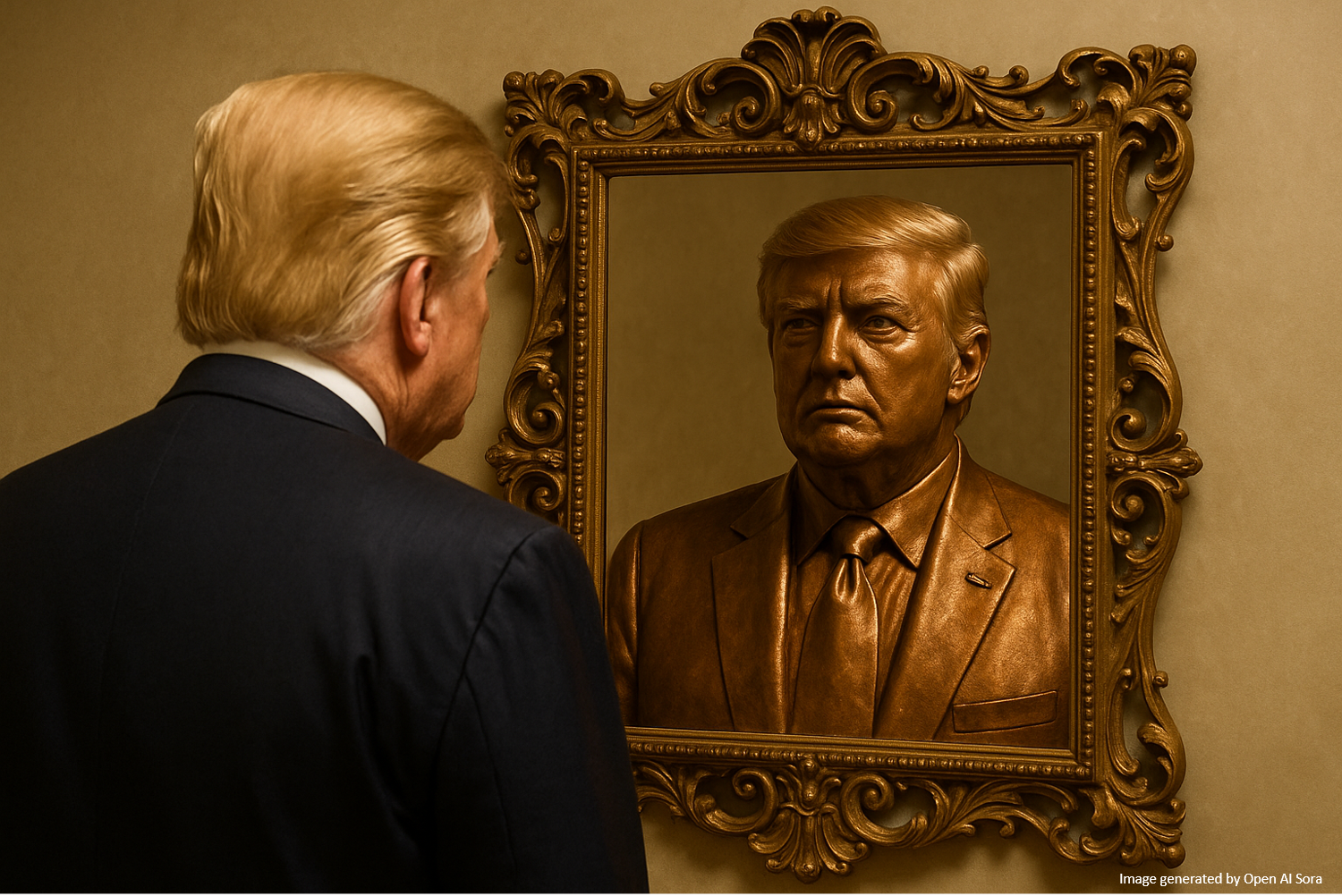
III. The Bronzer Age
I call this new era “The Bronzer Age,” inspired by a man who apparently applies makeup with a spatula. Trump’s second presidency is bringing his vision for America into focus:
1. Ending DEI programs. Trump is rescinding protections for minorities by attacking affirmative action, equal opportunity programs, and anything promoting fairness and benefits for anybody who is not a white male. Unless stopped by the courts, he threatens to return the United States to the Jim Crow era, Bouie’s “third republic.”
2. Personalizing History. In March, Trump signed an Executive Order enforcing his view of American history and purging information he objects to in places like the Smithsonian Institution and the National Museum of African American History and Culture. “There’s no way that rewriting a history to fit one president’s vision is good for a nation’s health or good for a nation’s democracy,” noted The Atlantic journalist, Jonathan Lemire. “Let’s be blunt,” he added, “This is really bad and really, really dangerous.”
3. Militarize the cities. Trump deployed the American military to Los Angeles and Washington, D.C., alleging local authorities won’t keep them safe. “I guarantee you that every one of these shootings was with an illegal gun,” said U.S. Attorney for the District of Columbia Jeanine Pirro, while defending Trump’s federal takeover. “It’s guns on the streets.” (Isn’t the answer fewer guns, not more troops?) Trump promises “a drastic escalation of federal presence on the streets of American cities,” reports USA Today. "We're not going to lose our cities over this” he said. “This will go further.”
4. Build detention camps. The Republican majority in Congress allocated “$45 billion for building new immigration detention centers, including family detention facilities.” “How the world so dearly loves a cage,” said Ruth Gordon as Maude Chardin in Harold and Maude. So does Trump.
5. Desensitize the population. Trump wants to normalize troops on the streets and the presence of detention camps.
6. Impoverish all but the elite. “The Republicans’ ‘big, beautiful bill’ will make the poorest Americans even poorer, while padding the wallets of the highest earners the most,” reports The Hill. Representative Brendan Boyle referred to it as “the largest transfer of wealth from working Americans to the ultra-rich in history.” Trump’s tariff scheme will primarily impact low and middle income households. This will exacerbate a pre-existing concentration of wealth.
7. Create a one-party (MAGA) state. “The Trump administration has launched a concerted drive to undermine American elections,” notes the Brennan Center for Justice, adding, “As the 2026 midterms approach, that effort will likely gather momentum.” The efforts include attempts to dilute minority voting through “Trumpmandering,” and using the justice system to target perceived political enemies.
These seven steps are the schematic of fascism. If fully implemented, what Jamelle Bouie calls “the fourth American republic” will be over. There is still time to save the Republic, if Americans want to keep it.
“I feel that much of the world's sorrow comes from people who are this,” Maude Chardin told Harold, while holding a daisy. Then, gesturing toward rows of identical tombstones, adds, “yet allow themselves to be treated as that.”
How will Americans allow themselves to be treated?